Men's Kurta Pajama Guide: Wedding, Silk & Casual Styles for Every Occasion
by Design Dhaga Team (trusted sources)
29-June-2026
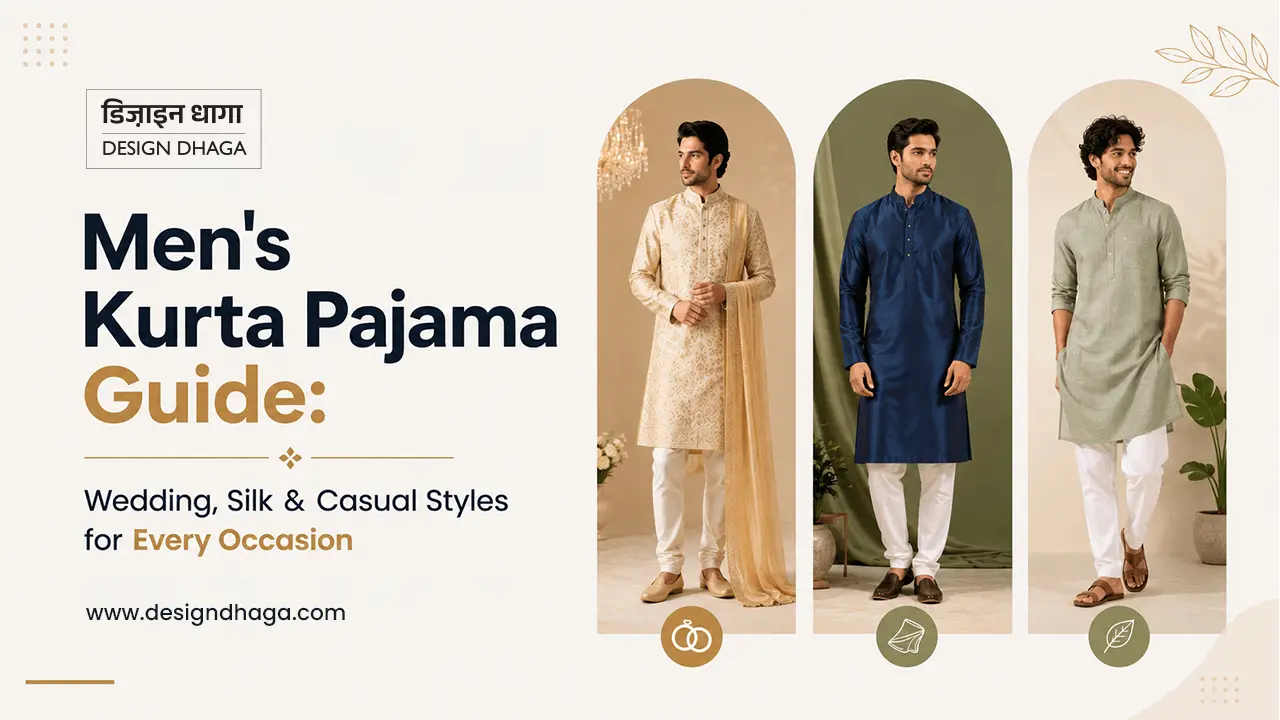
Walk into any wedding, festival, or family function in India, and you'll see the same garment doing all the work; the kurta pajama. It's been the default men's ethnic outfit for generations and yet most men still default to whatever's hanging in the store without thinking about fabric, fit, or occasion.
That's a missed opportunity. A well-chosen kurta pajama can look completely different depending on the fabric you pick, how it's cut and what you pair it with. Let's break down exactly what to look for, so the next one you buy actually earns its place in your wardrobe.
Why the Kurta Pajama Has Never Gone Out of Style
Most Western formalwear has a shelf life. Trends shift every few years, and what looked sharp a decade ago can look dated today. The kurta pajama has largely escaped that cycle. The silhouette is simple, comfortable, and adaptable, which means it works as easily for a wedding sangeet as it does for a Sunday lunch with family.
What changes isn't the basic shape. It's the fabric, the embroidery, the colour, and the styling around it. Understanding those variables is what separates a kurta pajama that looks effortless from one that looks like it was grabbed off a rack in a hurry.
Choosing the Right Fabric for the Occasion

Silk Kurta Pajama
Silk is the obvious choice when you want a kurta pajama to feel festive and substantial. It catches light beautifully, drapes well, and immediately signals "occasion wear" the moment you put it on. This is your go-to fabric for weddings, receptions, and major festivals like Diwali or Eid.
The trade-off is breathability. Silk holds heat, so it's better suited to evening functions or air-conditioned venues than a long daytime outdoor wedding in peak summer.
Cotton Kurta Pajama
Cotton is the practical, everyday counterpart to silk. It breathes well, washes easily, and holds up to repeated wear, which makes it the right choice for daily wear, casual family gatherings or warm-weather festivals where comfort matters more than shine.
A good cotton kurta pajama especially one with subtle hand-painted or block-printed detailing can still look intentional and put-together without trying to compete with silk's festive weight.
Linen and Cotton-Silk Blends
If you want something in between, linen and cotton-silk blends offer a middle ground: more texture and drape than plain cotton, but lighter and more breathable than pure silk. These work well for daytime wedding functions, engagement ceremonies, or semi-formal events where you want to look elevated without overheating.
Matching the Kurta Pajama to the Occasion

Weddings and Receptions
This is where richer fabrics and detailing earn their place. A silk or silk-blend kurta with fine embroidery, a Nehru jacket layered on top or subtle zari work on the collar and cuffs all read as appropriately festive. Deeper colours like maroon, bottle green, navy, and gold-toned beige tend to photograph well under wedding lighting.
Festive Occasions (Diwali, Eid, Puja etc.)
Festive wear sits a notch below bridal intensity but still calls for colour and a bit of shine. A silk-cotton blend in a rich jewel tone, paired with a simple churidar or straight-cut pajama, hits the right note without being overdressed for a family gathering.
Everyday and Casual Wear
For daily wear, simplicity wins. A solid-colour cotton kurta in white, beige, or a muted pastel, paired with straight-fit pajama or even jeans for a fusion look, is comfortable enough for all-day wear and still looks deliberate rather than thrown together.
Office or Semi-Formal Settings
Increasingly, men are wearing structured, collared kurtas as a fusion alternative to a shirt for semi-formal workplace settings. A well-fitted cotton or linen kurta in a neutral tone, paired with tailored pajama or even trousers, can work surprisingly well for client meetings or festive-season office days.
Getting the Fit Right

Length : Kurta length is one of the most overlooked details. A kurta that's too long can look bulky and old-fashioned, while one that's too short can look mismatched with traditional pajama. As a general rule, a length that falls somewhere between mid-thigh and just above the knee works for most builds and most occasions, though taller men can comfortably go slightly longer.
Sleeve and Shoulder Fit : The shoulder seam should sit right at your natural shoulder line not drooping past it. Sleeves should be full-length and comfortably loose without bunching excessively at the wrist. A kurta that's too tight across the chest or shoulders will always look like it doesn't belong to you, regardless of how good the fabric or embroidery is.
Pajama and Bottom Pairing : The traditional straight-cut pajama remains the most versatile pairing, but churidar (a more fitted, gathered-at-the-ankle style) has become popular for a sleeker, more contemporary silhouette, especially for weddings. For casual wear, some men pair kurtas with simple straight-fit trousers or even well-fitted jeans for a relaxed, fusion look.
A Note on Embroidery and Detailing

Heavy embroidery, mirror work, or zari detailing is wonderful for weddings and bridal-adjacent functions but it can look out of place anywhere else. If you're buying a kurta pajama you want to wear more than once a year, lean toward subtle detailing, a fine border, a delicate collar pattern, or minimal threadwork that doesn't lock the outfit into one specific event.
This is also where hand-painted detailing has an advantage over machine embroidery. A hand-painted motif, whether it's a subtle floral pattern or an abstract design, gives the kurta a one-of-a-kind character without the heaviness that heavy embroidery can bring. It also tends to age better, since it doesn't fray or loosen the way stitched embellishment sometimes does.
Building a Small Kurta Pajama Wardrobe : You don't need a kurta for every conceivable event. A thoughtfully built set of three or four can cover almost everything:
- One silk or silk-blend kurta in a deep, festive colour for weddings and major celebrations
- One cotton or linen kurta in a neutral tone for everyday and casual wear
- One kurta with subtle hand-painted or minimal embroidered detailing that works for both festive and semi-formal settings
- One lighter, breathable cotton kurta specifically for summer daytime functions
With these four in rotation, you're rarely caught without the right option, regardless of what the invitation calls for.
Mistakes to Avoid
- Don't buy a kurta in a fabric that doesn't suit the season. A heavy silk kurta at a daytime summer wedding will be uncomfortable no matter how good it looks in photos.
- Don't ignore proportions. An oversized kurta with a slim-fit pajama (or vice versa) creates an unbalanced silhouette.
- Don't over-accessorize. One statement piece, whether it's a Nehru jacket, a stole, or a pocket square, is usually enough. Stacking multiple statement pieces competes for attention.
- Don't skip trying it on before the event. Fabric that looks fine on a hanger can drape very differently once it's actually worn and moving.
Final Thoughts
The kurta pajama is one of the most adaptable pieces in Indian menswear, but that adaptability only works in your favor if you choose fabric, fit, and detailing with the occasion in mind. A well-chosen silk kurta for a wedding, a breathable cotton one for daily wear, and one versatile hand-painted piece in between will take you further than a closet full of kurtas bought without much thought.
Looking for a kurta pajama that's genuinely one-of-a-kind? Browse our kurta pajama collection for wedding, silk, and casual styles, or explore our men's shirts if you're building out the rest of your wardrobe. And if you want something with hand-painted character, check out our men's hand-painted t-shirts for a more casual, artistic take on menswear.
Frequently Asked Questions
Q: What is the best fabric for a kurta pajama at a wedding?
Silk or silk-blend fabrics are the best choice for weddings since they drape well catch light beautifully and read as appropriately festive. For daytime summer weddings, a lighter silk-cotton blend is more comfortable than pure silk.
Q: How long should a kurta be?
A length falling between mid-thigh and just above the knee works for most builds. Taller men can go slightly longer, while shorter men generally look more proportionate with a slightly shorter length.
Q: What's the difference between pajama and churidar with a kurta?
Straight-cut pajama is the traditional, looser-fitting option, while churidar is more fitted and gathered at the ankle for a sleeker, more contemporary silhouette. Churidar is popular for weddings, while straight pajama remains the everyday choice.
Q: Can a kurta pajama be worn casually?
Yes. A simple cotton or linen kurta in a neutral colour paired with straight-fit pajama or even jeans works well for casual, everyday wear without looking overdressed.
Q: What makes hand-painted kurtas different from embroidered ones?
A hand-painted kurta has its design applied directly onto the fabric by an artisan, which means no two pieces are exactly alike. It tends to offer a lighter, more versatile look than heavy embroidery, since the detailing doesn't add bulk or weight to the fabric.
Q: How many kurta pajamas does a man actually need?
A practical starting wardrobe is three to four; one silk or silk-blend piece for weddings and major occasions, one cotton or linen piece for daily wear, one with subtle detailing for festive or semi-formal settings, and one lightweight cotton piece for summer.
.webp)
.webp)
.webp)
.webp)

.webp)
.webp)
.webp)


 Continue with Google