Tanchoi vs Banarasi Saree: Understanding India's Handwoven Textile Heritage
by Divya Maherda
18-July-2026
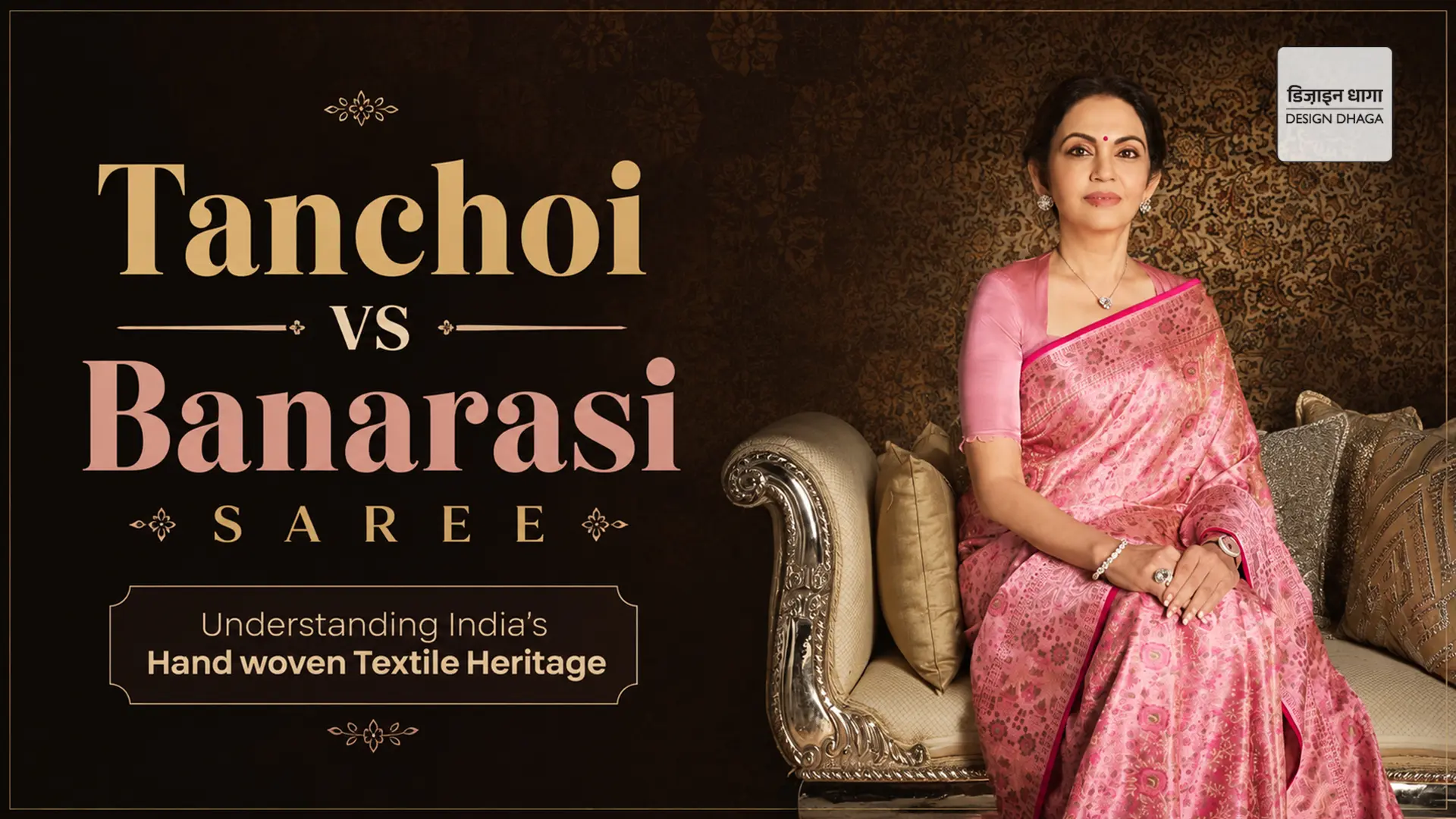
A hand-woven Tanchoi saree recently made headlines and it got a lot of people asking the same question, isn't that just a Banarasi saree? Not quite. Tanchoi is actually a type of Banarasi weave, but one with its own distinct technique, history and look. If you've ever stood in front of a saree rack wondering why one Banarasi costs so much more than another or why some pieces have that unmistakable smooth, almost painted on pattern while others have a raised, textured motif this is exactly the kind of detail that explains it.
At Design Dhaga, we spend our days thinking about textile traditions like this one, because our own hand-painted sarees draw from the same deep well of Indian craftsmanship. So let's break down what actually separates a Tanchoi from a classic Banarasi and why it matters if you're buying one.
What Is a Banarasi Saree?

"Banarasi" isn't one specific weave it's a broad family of silk sarees woven in and around Varanasi (Banaras), using techniques that go back centuries, believed to have been refined under Mughal patronage. What defines a Banarasi saree is the use of fine silk, real or metallic zari (gold/silver thread), and elaborate brocade work, often inspired by Mughal motifs like florals, paisleys, and jhallar (a decorative border pattern).
Under this umbrella, you'll find several distinct sub-types, including Katan, Kadhwa, Jangla, Cutwork and Tanchoi, each with a different weaving method and finished look.
What Is a Tanchoi Saree?
Tanchoi is one of the more technically demanding weaves in the Banarasi family. Instead of using extra threads to create a raised or embossed pattern (as many Banarasi weaves do), Tanchoi uses a technique where the weft threads themselves form the design directly into the fabric resulting in a saree with almost no visible float threads on the reverse side and a smooth, dense, closely-woven surface.
The design itself is said to have originated in China and travelled to Surat via Parsi traders in the 19th century, before being adapted by Banarasi weavers into what we now know as the Banarasi Tanchoi. The motifs are usually small, repetitive florals or birds, woven in a way that gives the fabric a satin-like sheen rather than a textured, embossed feel.
Tanchoi vs Banarasi: The Key Differences
|
Aspect |
Classic Banarasi (e.g., Kadhwa/Jangla) |
Tanchoi |
|
Weaving technique |
Extra weft threads create raised motifs |
Weft threads interlock to form pattern within the weave itself |
|
Texture |
Often textured, embossed feel |
Smooth, satin-like finish |
|
Reverse side |
Visible float threads/loose ends |
Neat, almost identical to the front |
|
Motifs |
Larger florals, paisleys, jhallar borders |
Smaller, delicate repetitive florals/birds |
|
Weaving time |
Time-intensive depending on complexity |
Extremely time-intensive due to precision required |
In short: every Tanchoi is a Banarasi, but not every Banarasi is a Tanchoi. It's a distinction of technique, not competing origins.
How to Spot an Authentic Handwoven Piece

Whether it's a Tanchoi, a Kadhwa or any other handwoven Banarasi, a few things help separate genuine handloom work from power-loom imitations:
- Check the reverse side : genuine handwoven silk shows the weave pattern clearly on the back too. (especially true for Tanchoi, where the back looks nearly identical to the front)
- Feel the weight and drape : handwoven silk has a natural heaviness and fluid drape that machine-made synthetic blends don't replicate.
- Look for small irregularities : a slightly imperfect motif or an uneven zari line is often a sign of human hands at work, not a flaw.
- Ask about the source : genuine Banarasi weaves are still largely handwoven in and around Varanasi by artisan families, often working on traditional pit looms.
Where Hand-Painted Craft Fits In

Handloom weaving and hand-painting are two very different crafts, but they come from the same place, a respect for slow, human-made textiles over mass production. At Design Dhaga, our sarees and ethnic wear are hand-painted rather than handwoven but the philosophy is identical every piece carries the individual hand of the artisan who made it, which means no two pieces are ever exactly alike.
If you love the idea of wearing something rooted in genuine Indian craftsmanship, whether handwoven or hand-painted, it's worth looking closely at how a piece is made not just what it looks like on a hanger.
Explore our hand-painted saree collection at designdhaga.com, or chat with us on WhatsApp if you'd like help picking a piece for a specific occasion.
“Frequently Asked Questions”
1. What is the difference between a Tanchoi saree and a Banarasi saree? Tanchoi is actually a type of Banarasi saree, not a separate category. The difference lies in the weaving technique. Tanchoi uses weft threads to form the pattern directly within the weave, giving it a smooth, satin-like finish, while other Banarasi weaves like Kadhwa create a more raised, textured motif.
2. Why are Tanchoi sarees more expensive? Tanchoi weaving is highly labour-intensive because the pattern is created through precise interlocking of weft threads rather than simpler extra-weft techniques. This requires greater skill and more time on the loom, which reflects in the price.
3. Is Tanchoi saree suitable for weddings? Yes. Because of its fine, dense weave and subtle sheen, Tanchoi sarees are often chosen for weddings and festive occasions where a rich, elegant look is preferred over heavier, more textured brocade work.
4. How do I identify a genuine handwoven Banarasi saree? Check the reverse side of the fabric, handwoven pieces show the pattern clearly on the back as well. Also look for natural drape, weight, and small irregularities in the motifs, which are signs of handloom work rather than machine production.
5. What are the different types of Banarasi sarees? The main types include Katan, Kadhwa, Jangla, Cutwork and Tanchoi each distinguished by its weaving technique and finished texture.
6. Where are Tanchoi and Banarasi sarees made? Both are traditionally woven in and around Varanasi (Banaras), Uttar Pradesh by artisan weaving families, many of whom still use traditional pit looms passed down through generations.
7. Can hand-painted sarees be styled the same way as handwoven ones? Absolutely. Hand-painted sarees like those at Design Dhaga can be styled just as elegantly for festive or formal occasions, offering a different but equally rich form of artisan craftsmanship compared to handwoven silk.

.webp)

.webp)
.webp)
.webp)

.webp)
.webp)


 Continue with Google