How to Identify Genuine Handpainted Clothing : A Complete Buyer's Guide
by Priti Sharma
22-July-2026
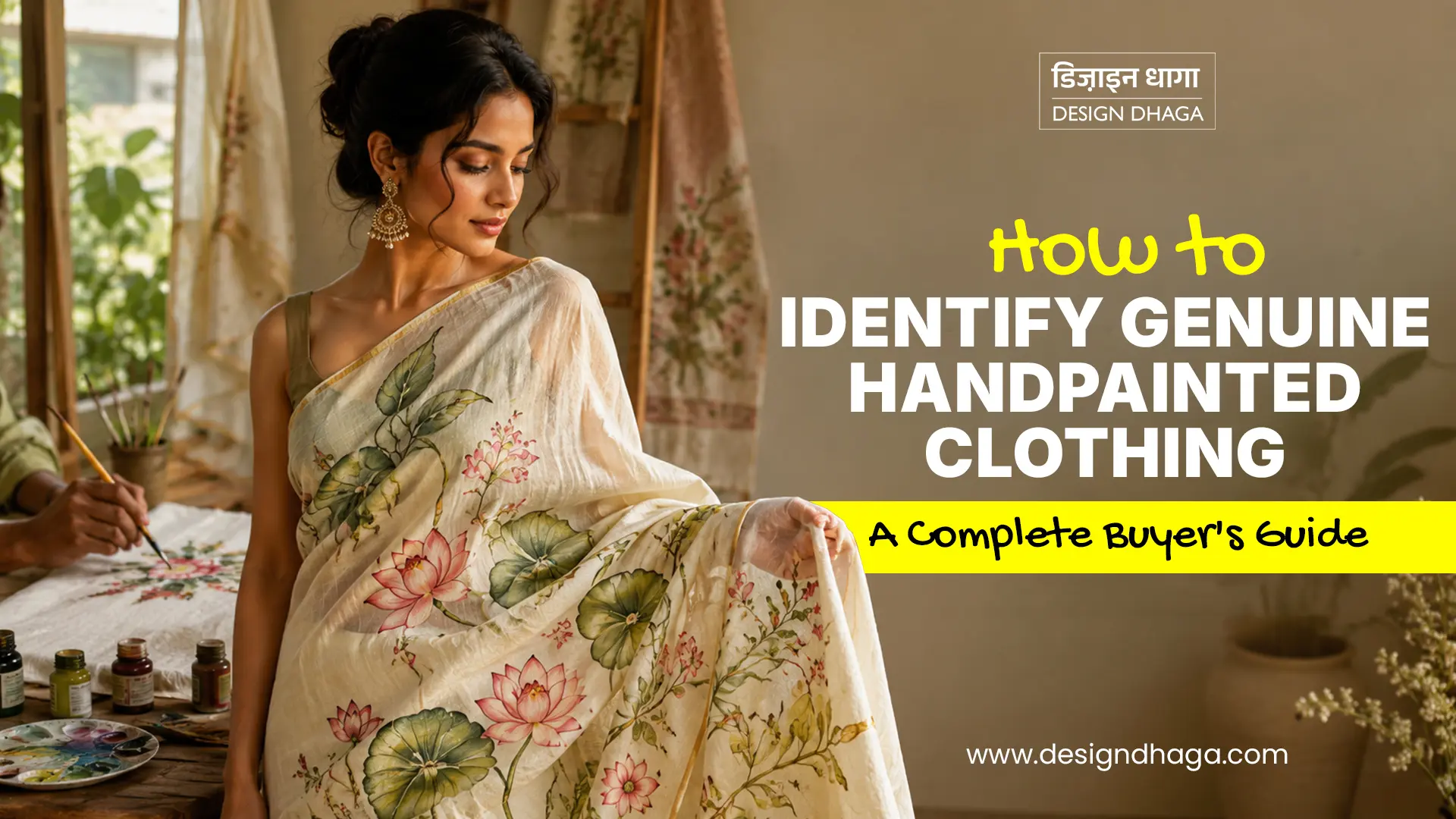
"Handpainted" has become one of the most overused words in Indian ethnic wear marketing. A genuine handpainted garment, where a skilled artisan applies paint, dye or pigment directly to fabric by hand is a fundamentally different product from one that is machine-printed with a brush-stroke texture to simulate handpainting. The difference matters because one is a piece of wearable art made by a human being with training and time, the other is a factory product wearing a craft label it hasn't earned.
This guide tells you exactly how to tell the difference, what to look for visually, what questions to ask, what answers should reassure you and what red flags should make you walk away. It also explains why genuine handpainted clothing deserves its higher price point and what India's handcraft tradition actually represents when you choose to support it.
Why "Handpainted" Is Being Misused

The demand for handcrafted, artisan-made clothing has grown significantly in India and globally over the last five years driven by a combination of environmental awareness, post-pandemic appreciation for slow fashion and the cultural validation that moments like India's Paris Haute Couture Week debut brought to Indian craft traditions. Wherever genuine demand exists, marketing follows and "handpainted" "handcrafted" and "handmade" are now applied to products that meet none of the criteria they imply.
This isn't always deliberate deception some sellers genuinely don't know the difference between hand-block-printing (which is handmade) and digital printing with a hand-texture effect (which is not). But for buyers paying a premium for genuine craft the distinction is exactly what they're paying for.
What Genuine Handpainted Clothing Actually Is
Genuine handpainted clothing is fabric on which a human artisan has applied paint, natural dye or fabric pigment directly using brushes, tools or fingers without the intermediary of a screen, block or digital printing process. Each piece is therefore:
- Unique: No two genuinely handpainted pieces are identical, even in the same pattern the brushwork will vary naturally between one artisan's hand and the next stroke.
- Variable: Slight colour variation, brushwork differences and minor irregularities are features of genuine handpainted work not defects.
- Time-intensive: A single handpainted saree or kurta can take anywhere from a few hours to several days of artisan work depending on the complexity and size of the pattern.
- Skill-dependent: The quality of handpainted work reflects the artisan's training, technique and experience, there is no machine setting that can be adjusted to fix a poorly executed brushstroke.
Part 1: Visual Tests - What to Look for When Examining a Piece

Test 1: Check for Natural Variation Within the Pattern
This is the single most reliable visual test for genuine handpainted clothing.
In genuine handpainted work: the pattern will have natural variation across the garment. If a floral motif appears in ten places across a saree, each instance will be slightly different, the petal thickness, the colour saturation, the line weight. This variation is not inconsistency, it is the signature of a human hand at work.
In machine-printed work: the pattern repeats with perfect mechanical uniformity. Every instance of the same motif is identical same size, same colour saturation, same line weight. Perfect uniformity is a machine's signature, not an artisan's.
How to check: Hold the garment up and look at the same motif repeated across the fabric. If every repetition is a perfect copy, it is almost certainly machine-printed. If each repetition has slight natural differences, it is almost certainly genuine handpainted or hand-blocked.
Test 2: Examine the Brushstroke or Paint Edge Quality

Genuine handpainted fabric shows the characteristic quality of paint applied with a brush or tool, slightly feathered or textured edges, varying paint thickness within a single stroke and occasional fine lines where the brush's bristles separated during application.
Machine-printed simulations of brushwork have:
- Perfectly uniform edge definition across every "brushstroke"
- Even, identical paint thickness throughout.
- No variation in the direction or weight of individual strokes.
How to check: Look closely at the edges of painted lines and motifs, ideally with a phone camera zoom or a small magnifying glass. Feathered, slightly irregular edges indicate genuine paint application. Perfectly sharp, uniform edges indicate printing.
Test 3: Check the Reverse Side of the Fabric

For genuinely handpainted fabric using fabric paint or natural dyes the colour will have penetrated through to the reverse side of the fabric not as vividly as the front, but visibly present.
Machine printing typically sits on the fabric's surface — the reverse side is either completely uncoloured or shows only a faint, blurry shadow of the front pattern rather than the paint's actual penetration into the fibre.
How to check: Turn the garment inside out and look at the reverse of a heavily painted area. If you can see the colour has genuinely penetrated through the fabric, that supports genuine handpainting. A completely white or blank reverse on a darkly painted front is a red flag.
Test 4: Look for the Artisan's Hand in the Details

Genuine handpainted clothing particularly detailed figurative or floral work often contains small details that reveal the artisan's personal style, the specific way they end a brushstroke, the way they handle colour transitions, tiny additional marks or embellishments added at the end of a section. These personal details are invisible in machine printing, where every element is mechanically reproduced.
How to check: Look at the smallest, finest details in the design the tips of petals, the ends of stems, tiny dot or line accents. If these show slight variation in execution between different areas of the garment, a human hand made them.
Part 2: Questions to Ask the Seller

Visual inspection is important but not always sufficient particularly when buying online or from a retailer who stocks a large volume of product. The questions you ask and the quality of the answers you receive are as revealing as the garment itself.
"Who painted this piece, and where?"
A genuine handpainted clothing brand can answer this question. The answer might be a specific artisan's name, a community (e.g. "our artisan cluster in Jaipur") a region, or at minimum a clear description of the production process. An answer of "our factory" or "we don't know" should raise concern.
"How long does a piece like this take to make?"
Genuine handpainted work takes time, a simple motif on a kurta might take 2-4 hours, a complex full-saree painting might take several days. If the seller can't give you a realistic time estimate or gives you an answer that seems impossibly fast for the complexity you're looking at, the production process is worth questioning.
"What type of paint or dye is used?"
Legitimate answers include: fabric paint, natural dyes (indigo, madder, pomegranate) pigment dyes, acid dyes for silk, or discharge printing (for specific techniques). An inability to answer this question or a vague answer like "special colours" suggests the seller doesn't know the production process closely enough to be selling genuine handcraft.
"Can I see the process any behind-the-scenes photos or videos?"
Genuine handpainted clothing brands almost always have documentation of their production process photos of artisans at work, videos of the painting process or at minimum images from the atelier or workshop. A complete absence of production documentation for a brand selling "handpainted" clothing is a significant red flag.
"Is each piece unique, or are they produced in sets?"
Genuine handpainted clothing is made in small batches or individually — the time required for hand painting limits production volume significantly. A brand selling hundreds of identical "handpainted" pieces at very low prices is almost certainly machine printing. Genuine handpainted pieces are typically sold in limited quantities, often with slight variation between pieces acknowledged as a feature.
Part 3: Red Flags - When to Walk Away
Price Too Low for the Claimed Work
Handpainting is skilled, time-intensive labour. A genuine handpainted saree or kurta involves hours of artisan work and the price should reflect that. If a "handpainted" piece is priced at or below the cost of equivalent machine-made clothing the "handpainted" claim is almost certainly false.
This doesn't mean genuine handpainted clothing must be unaffordably expensive smaller pieces (accessories, stoles, children's clothing) with simpler designs can be genuinely handpainted at moderate prices. But complex full-garment painting at fast-fashion prices is not credible.
Perfect Pattern Uniformity at Scale
As noted in Test 1 above, perfect mechanical uniformity across a large-scale pattern is a machine's signature. If a brand is selling dozens of pieces in the same pattern with no visible variation between them, they are machine-printing regardless of what the label says.
"Digital Handpainted" or "Handpainted Print"
These phrases are marketing contradictions digital printing is not handpainting and a print cannot be handpainted. Any product described with these phrases is machine-printed with a simulated handpainted aesthetic. This is not inherently a problem digital prints can be beautiful, but they should not be priced or marketed as genuine handcraft.
No Information About Artisans or Production Location
Genuine handcraft brands know who makes their products. If a brand's website, packaging and sellers cannot tell you anything about who made the piece, where or how they are almost certainly not closely connected to the production process, which typically means the "handmade" or "handpainted" claim is not genuinely supervised.
Returns Policy That Doesn't Account for Variation
Genuine handpainted clothing will have slight natural variation between pieces a reputable brand selling genuine handcraft will explicitly acknowledge this in their product descriptions and returns policy, noting that variation is expected and not a defect. A brand that claims perfect consistency across all pieces while also claiming genuine handpainting is contradicting itself.
Part 4: The Different Types of Genuine Handcraft in Indian Clothing

Understanding the range of genuine handcraft techniques in Indian clothing helps you evaluate what you're looking at more accurately:
Direct Handpainting (Kalamkari and Related Techniques)
Kalamkari literally "pen work" is the tradition of painting directly on fabric using a pen-like tool (kalam) dipped in natural dye. The technique originated in Andhra Pradesh and Telangana and produces distinctive figurative paintings of Hindu mythological scenes, temple imagery, and natural motifs. Genuine Kalamkari involves mordanting the fabric, applying natural dyes in sequence and detailed freehand drawing the process for a single piece can take weeks.
Block Printing (Handmade, Not Handpainted)
Block printing uses a hand-carved wooden or metal block inked and pressed onto fabric, it is genuine handcraft, but it is not handpainting. Block-printed fabric has the clean edge of a block rather than the brushstroke quality of painting, and each print impression shows the block's texture rather than the free movement of a brush. This is a valuable distinction, block printing is authentic Indian handcraft, but calling it "handpainted" is technically inaccurate.
Batik (Wax-Resist Dyeing)
Batik uses hot wax applied to fabric to resist dye, creating patterns where the wax was applied. Genuine batik produces a characteristic "crackle" effect where dye has seeped through fine cracks in the wax, this crackle is the genuine article's most identifiable feature and cannot be perfectly replicated by printing.
Natural Dye Work
Fabric dyed using natural sources (indigo, madder root, pomegranate rind, turmeric) is genuine handcraft even when the dyeing is the only hand process involved. Natural-dyed fabric has a specific depth and variation of colour that synthetic dyes cannot replicate and natural dyes fade differently over time (often more beautifully) than synthetic equivalents.
Handpainted Accessories
Handpainted accessories bags, footwear, jewellery follow the same visual tests as handpainted clothing with the additional advantage that the smaller scale often makes brushwork details more visible and easier to examine.
Part 5: Why Genuine Handpainted Clothing Is Worth the Premium

If you've read this far the case is largely made but it's worth stating directly:
A genuine handpainted garment is a piece of wearable art. It represents hours of a skilled artisan's working life. It is unique, no other person in the world owns an identical piece. It carries the specific aesthetic sensibility of the human being who made it and it participates in a craft tradition that connects contemporary clothing to centuries of Indian artistic heritage.
The premium over machine-printed equivalents is not for the brand's margin, it is for the artisan's time, skill and the irreplaceable human quality of work made by hand. India's handcraft sector employs millions of artisans whose livelihoods depend on genuine demand for genuine handcraft. Buying genuine and paying what genuine costs is the most direct way to support that ecosystem.
The Paris Haute Couture Week 2026 moment, where Indian craft traditions competed with and impressed the world's most demanding fashion audience, was built on exactly this foundation: human skill, human time and human creativity applied directly to fabric. That's what genuine handpainted clothing. That's what the premium is for.
Common Mistakes to Avoid When Buying Handpainted Clothing
- Buying based on price alone - the lowest price in a "handpainted" category is almost never genuine handcraft
- Accepting "digital handpainted" as equivalent - it is not; it is machine printing
- Not checking the reverse side - this single test rules out most machine-print impostors
- Assuming a GI tag covers all handcraft - GI tags exist for specific regional crafts; many genuine handcraft traditions are not GI-tagged
- Not asking about artisans - a brand that cannot tell you who made the piece is not closely connected to genuine handcraft production
Final Thoughts
Genuine handpainted clothing asks something of you as a buyer a slightly higher price a willingness to accept natural variation and the patience to ask questions before purchasing. In return, it gives you something no machine can produce, a garment made by a human being, for you specifically, carrying the specific quality of that person's skill and time.
Every piece of genuinely handpainted clothing from Design Dhaga is made by skilled Indian artisans painted by hand, one piece at a time with no machine shortcuts. The slight variation between pieces is not a quality issue, it is the proof that a human being made it.
Explore our handpainted collection - sarees, kurtas, accessories and more at the Design Dhaga Shop.
“Frequently Asked Questions”
Q: What is the difference between handpainted and block-printed clothing? Handpainted clothing is created by an artisan applying paint or dye directly to fabric using brushes or tools, each piece is unique and shows free brushwork. Block-printed clothing uses a hand-carved block inked and pressed onto fabric, it is genuine handcraft but produces more uniform repetition than freehand painting. Both are legitimate handcraft; neither is machine printing, but they are different techniques.
Q: How can I tell if a fabric is genuinely handpainted or digitally printed? The most reliable tests, check for natural variation in repeated motifs (genuine handpainting varies, machine printing is perfectly uniform) examine the paint edge quality under magnification (genuine brushwork has feathered edges, printing has sharp uniform edges) and check the reverse side of the fabric (genuine paint penetrates through, printing sits on the surface).
Q: Why does genuine handpainted clothing cost more than machine-printed equivalents? Genuine handpainting requires hours of skilled artisan labour per piece - a complex handpainted saree can take days of work. The premium over machine-printed alternatives reflects the artisan's time, skill, and the unique, irreproducible quality of hand-applied work. It also directly supports India's handcraft artisan communities.
Q: Is natural variation in handpainted clothing a defect? No - it is the opposite of a defect. Natural variation between pieces is the definitive proof of genuine handcraft. Perfect uniformity is a machine's achievement, slight natural variation is a human artisan's signature. Any brand selling genuine handpainted clothing will explicitly acknowledge this variation as a feature, not a flaw.

.webp)

.webp)
.webp)


.webp)
.webp)


 Continue with Google