Hand Painted T-Shirts: Designs, Fabric Paint & How to Buy Genuine
by Priti Sharma
14-August-2026
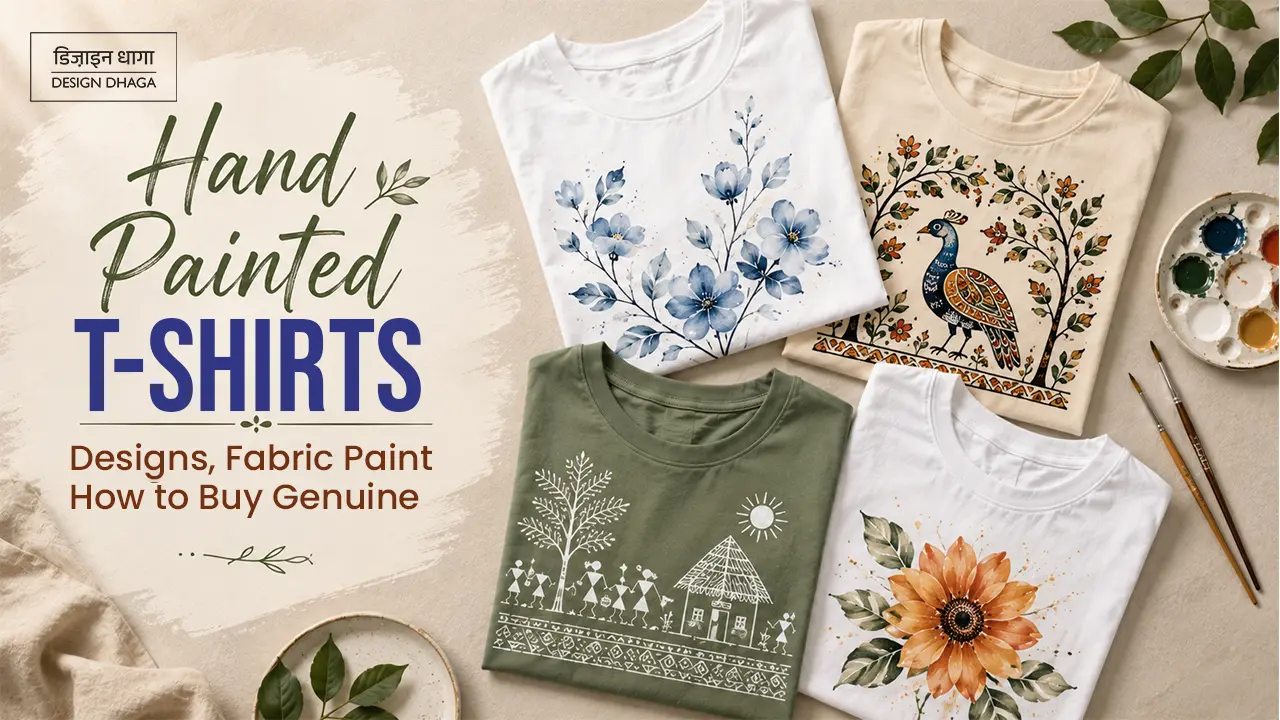
A hand painted t-shirt is one of the most direct expressions of wearable art available a plain piece of fabric transformed by an artisan's hand into something that carries personality, skill and a story that no machine printed equivalent can replicate. In India hand painted t-shirts sit at the intersection of two powerful 2026 trends, the global rise of slow fashion and the growing appreciation for Indian artisan craftsmanship that Paris Haute Couture Week brought to the world's attention earlier this year. This guide covers everything the most popular design styles the right fabric paints for different effects, a step-by-step guide for those who want to paint their own, how to style hand painted t-shirts for men and women and how to identify genuinely handpainted pieces before buying.
Why Hand Painted T-Shirts Are Having a 2026 Moment
The hand painted t-shirt has always existed at the edge of fashion worn by artists, craft enthusiasts and people who want their clothing to reflect something specific about who they are. What has changed in 2026 is that this category has moved from the periphery to the mainstream, driven by three specific shifts.
The slow fashion movement has reached mass awareness. Buyers are actively questioning where their clothing comes from who made it and how long it will last. Each hand painted shirt turns into wearable art every piece tells its own story and adds depth to a wardrobe, showcasing individuality as a statement piece. That individuality is precisely what the slow fashion movement rewards clothing made by a specific human being for a specific purpose that cannot be mass-produced.
Indian artisan craft is having its global moment. The Paris Haute Couture Week 2026 debut of four Indian designers celebrated on this blog placed Indian handcraft traditions on the world's most prestigious fashion stage. Hand painted textiles including t-shirts are part of the same tradition, Indian artisans applying colour and design to fabric by hand in techniques refined across generations.
The authenticity premium is real. Buyers in 2026 are willing to pay more for genuinely handmade pieces than for machine-printed alternatives provided they can verify the handmade claim. This guide's section on identifying genuine hand painted pieces addresses exactly that verification process.
Part 1: Popular Hand Painted T-Shirt Design Styles
Floral Designs : The Most Universally Loved Category

Floral hand painted t-shirt designs are the most consistently popular category across all age groups, genders and occasions. The reason is simple, flowers are visually rich, culturally universal and adaptable to an enormous range of styles from tight, botanical illustration-style florals to loose, impressionistic brushwork without requiring the viewer to decode any specific reference or meaning.
Indian folk floral designs: Madhubani-inspired florals, Warli-influenced botanical patterns and Meenakari-style flower motifs bring India's folk art traditions onto a contemporary garment format. These designs work particularly well on white or natural cotton t-shirts, where the colourful motifs read clearly against the plain ground.
Watercolour florals: Loose, bleeding-edge floral designs that use the watercolour technique's characteristic soft edges and colour blending. Best achieved on pre-washed, slightly damp fabric that allows the paint to spread naturally. The result is a design that looks simultaneously casual and sophisticated as if the flowers have grown onto the fabric rather than been placed there.
Flower painting on t-shirt, the single flower approach: One large detailed flower painted at the chest or back of a t-shirt surrounded by negative space. This approach creates more visual impact than an all-over floral pattern precisely because the negative space amplifies the painted element rather than competing with it.
Indian Folk Art and Traditional Motifs

Indian folk art traditions translate exceptionally well onto t-shirt format the bold lines, flat colour fills and geometric structure of Madhubani, Warli, Kalamkari and Pattachitra all work at t-shirt scale in a way that more detailed fine art painting does not.
Madhubani on t-shirts: Madhubani's characteristic black outlines and flat vibrant colour fills work well with fabric paint markers for the line work and fabric paint for the fills. Fish, elephants, peacocks and the sun and moon the most common Madhubani motifs are recognisable across cultures and photograph beautifully on white or natural cotton.
Warli on t-shirts: Warli's white-on-earthy background geometric figures humans, animals, trees and geometric patterns work particularly well on dark-coloured t-shirts where the white paint creates maximum contrast. A dark olive, ochre or terracotta t-shirt with white Warli figures is one of the most distinctive and culturally grounded t-shirt designs available.
Kalamkari on t-shirts: Kalamkari's pen drawn mythological figures and botanical border patterns can be adapted to t-shirt format by focusing on one central motif a deity, an animal or a botanical rather than attempting the full narrative scene typical of traditional Kalamkari cloth panels.
Pichhwai-inspired designs: Pichhwai's lush jewel-toned depictions of Lord Krishna and the lotus flower translate beautifully onto dark-coloured t-shirts the deep blues, greens and gold of Pichhwai palette work particularly well against dark navy, black or forest green base fabrics.
Abstract and Contemporary Designs
Abstract hand painted t-shirt designs allow the greatest creative freedom for the painter and the greatest range of styling possibilities for the wearer an abstract design carries no specific cultural reference which makes it wearable across more occasions and more outfit combinations than a representational design.
Geometric abstracts: Bold, clean geometric shapes circles, triangles, intersecting lines painted in a limited, strongly contrasting colour palette. These work well in fabric paint markers which produce clean, precise edges and are among the most beginner accessible of all hand painted t-shirt design styles.
Textural brush stroke designs: Large, expressive brushstrokes in 2-3 colours applied with a wide brush for maximum gestural quality. The design's appeal comes entirely from the quality and energy of the brushwork rather than any representational content which means the painting process itself is the creative act not the planning of a specific design.
Tie-dye effect with hand painting: A tie-dye or watercolour wash base layer (created with diluted fabric paint applied to damp fabric) combined with hand painted details over the top. This two-stage approach creates designs with genuine depth and complexity the wash layer provides a coloured ground and the painted details sit on top with full opacity.
Nature and Wildlife Designs
Nature and wildlife hand painted t-shirt designs have strong, consistent demand in India particularly designs featuring Indian wildlife (tigers, elephants, peacocks, lotus) which carry cultural and national significance beyond their visual appeal.
Peacock painting on t-shirt : The peacock is one of the most painted t-shirt motifs in India, its fan of feathers provides an inherently beautiful, radially symmetric design element that works at any scale. A peacock painted in full colour with detailed feather work is a technically demanding design, a stylised, graphic peacock with bold flat colour is accessible even for beginners.
Elephant designs: Indian elephant motifs particularly the decorated, festive elephant of Rajasthani and Kerala traditions are visually distinctive and carry immediate cultural recognition. These work particularly well on natural cotton or cream-coloured t-shirts where the earth tones of the traditional elephant design read most authentically.
Floral and botanical nature designs: Beyond flowers specifically, botanical designs leaves, branches, herbs, botanical illustrations of Indian plants are a growing design category that works well for both men's and women's hand painted t-shirts.
Part 2: Fabric Paint for T-Shirts : A Complete Guide
Choosing the right fabric paint is as important as the design itself. The wrong paint type creates a stiff, cracking or fading result that undermines even a beautifully conceived design. Here is everything you need to know about fabric paint before starting.
Types of Fabric Paint

Fabric-specific acrylic paint: The most commonly used and most versatile fabric paint for t-shirts. Fabric acrylic paint is specifically formulated to bond with textile fibers rather than sitting on the surface which means it does not crack or flake with washing and wear. Available in an enormous colour range, mixes easily and works on all natural fabric types.
Do not confuse fabric acrylic paint with regular acrylic paint regular acrylic paint applied to fabric without a fabric medium additive will crack and peel after washing, regardless of how carefully the painting is done.
Fabric paint with textile medium: Regular acrylic paint mixed with a fabric medium or textile medium additive becomes flexible and wash-resistant. This approach gives you access to the full range of regular acrylic colours (which is broader than most fabric-specific paint ranges) while achieving the wash fastness of purpose made fabric paint. The ratio is typically 2 parts acrylic paint to 1 part fabric medium adjust for desired consistency.
Fevicryl fabric colours: Fevicryl is the most widely available fabric paint brand in India and one of the most reliable for t-shirt painting projects. Fevicryl Fabric Colours are specifically designed for fabric painting on t-shirts, providing vibrant, wash-fast colour that bonds reliably with cotton and cotton-blend fabrics. Available at most craft stores and online, Fevicryl is the recommended starting point for anyone new to fabric painting.
Fabric paint markers and pens: Fabric markers apply paint in a controlled line rather than a broad wash making them ideal for detailed line work, outlines and fine-detail elements in any design. Particularly useful for folk art styles (Madhubani, Warli) where precise black outlines define the design's structure. Available in both fine-point and broad-tip formats.
Puff fabric paint: A specialized fabric paint that expands when heat-set creating a three-dimensional raised effect on the fabric surface. Useful for specific design elements that benefit from texture outlines, dots or border details but not suitable for large painted areas where the raised effect would become impractical.
Glow in the dark and metallic fabric paints: Specialty effect paints for specific design requirements. Metallic fabric paint gold, silver, copper works particularly well as an accent in Indian folk art designs where the metallic quality echoes traditional zari and gold leaf work. Glow-in-the-dark paint is popular for children's and youth market t-shirt designs.
Choosing the Right Fabric for Hand Painting
The fabric of the t-shirt determines how the paint absorbs, how the colours appear and how the finished piece wears over time.
100% cotton: The best base fabric for hand painting absorbs fabric paint evenly, allows colours to appear at full vibrancy and washes well without distorting the painted design. Pre wash the t-shirt before painting to remove sizing (the starch-like finish applied during manufacturing) that can prevent paint from bonding properly with the fibers.
Cotton-polyester blend: Acceptable for fabric painting but produces slightly less vibrant colour absorption than pure cotton. Polyester fibers resist paint bonding more than cotton does the higher the polyester content, the more resistance the fabric will show.
Black and dark-coloured t-shirts: Require opaque fabric paints standard transparent or semi-transparent fabric colours will not show up against dark grounds. Use paints specifically labelled as opaque or apply a white base layer and allow it to dry completely before applying the coloured design over the top.
White and light-coloured t-shirts: Work with any fabric paint type transparent, semi-transparent and opaque all produce strong results. White cotton is the most forgiving and most versatile base for first-time fabric painters.
Fabric Paint : Colour Mixing and Preparation
Mixing fabric paints: Most fabric paints mix reliably with each other when from the same brand combining paints from different manufacturers can sometimes produce inconsistent results. Test mixed colours on a scrap of the same fabric before applying to the t-shirt.
Consistency for different techniques: For a fluid, water colour style wash effect, thin fabric paint slightly with water no more than 10-15% water by volume as over thinning reduces wash-fastness. For crisp, opaque, fully saturated areas, use paint straight from the bottle.
Using a palette: Always mix and test colours on a palette (or a piece of old ceramic tile) before applying to the fabric. Colours often look different on the white palette surface versus on the fabric ground particularly on coloured or dark fabrics.
Part 3: Step-by-Step Guide to Painting a T-Shirt at Home

This process guide covers the basic method that applies to most hand painted t-shirt projects with specific variations noted for different design styles.
Step 1 : Prepare the T-Shirt
Wash the t-shirt in warm water without fabric softener and allow it to dry completely. Fabric softener leaves a coating on the fibres that can prevent paint from bonding properly this step is essential not optional.
Iron the t-shirt flat to remove all wrinkles. Wrinkles in the fabric during painting create uneven paint application and can cause the painted design to distort when the fabric is later smoothed out.
Place a piece of cardboard or a painting board inside the t-shirt between the front and back layers. This prevents paint from bleeding through to the back of the shirt and provides a firm, flat surface to paint against.
Step 2 : Transfer the Design
For beginners transferring a pre-drawn design onto the fabric before painting reduces the pressure of working freehand and allows you to focus on the painting process itself.
Carbon paper transfer: Draw or print your design on paper at the correct size. Place a piece of carbon paper face-down between the design and the t-shirt fabric. Trace over the design with a pencil or pen the carbon paper transfers a light outline onto the fabric. Trace the same design on the t-shirt using a yellow carbon paper, ensuring the design comes right in the centre of the t-shirt.
Light box or window transfer: Place the design under the t-shirt and hold both against a bright window or light box the light shows the design through the fabric allowing you to trace it directly onto the fabric with a fabric pencil or chalk.
Freehand for confident painters: Sketch the design directly onto the fabric with a white fabric pencil or tailor's chalk, which brushes off cleanly after painting. Most fabric pencil marks disappear completely under fabric paint; test on a scrap of the same fabric first.
Step 3 : Apply the Base Layers
Start with the largest areas of flat colour the background elements or the main shapes of the design using a wide, flat brush. Work from light colours to dark, since dark paint applied over wet light paint can muddy both colours.
Allow each layer to dry partially before applying the next colour adjacent to it. Complete dryness between layers is not always necessary but wet-on-wet application of strongly contrasting colours will cause them to bleed into each other which is sometimes desirable (for watercolour-style designs) and sometimes not (for folk art designs with clean colour separations).
Step 4 : Add Detail and Line Work
Once the base colour areas are fully dry add detail work outlines, fine lines, pattern elements, shading and highlights using a fine-point brush or fabric paint marker.
For Indian folk art styles, this is typically where the black outline work is added over the filled colour areas, defining the design's structure and creating the characteristic strong-line quality of styles like Madhubani and Warli.
For contemporary and abstract styles, this layer adds detail that creates depth highlights with a lighter colour, shadow with a darker one or texture marks that give the design a handmade quality.
Step 5 : Heat Set the Paint
Heat setting is the step that permanently bonds the fabric paint with the textile fibres. Skipping heat setting means the paint will fade, crack or wash out over time regardless of the quality of the paint used.
With an iron: Place a piece of parchment paper or a thin cotton cloth over the painted design. Iron over the top at medium heat (cotton setting) for 3-5 minutes, keeping the iron moving slowly rather than leaving it stationary over one spot. Allow to cool before removing the parchment paper.
With a clothes dryer: Place the painted t-shirt in a dryer at high heat for 30-40 minutes after the paint has air-dried completely. This is an acceptable alternative to ironing and is particularly useful for designs with intricate detail that might be difficult to iron over carefully.
Waiting period before heat setting: Allow the painted design to air-dry completely before heat setting usually 24 hours for most fabric paints. Rushing the drying process by applying heat too early can cause paint to move or bubble rather than bond cleanly.
Step 6 : Care After Painting
Wait 72 hours after heat setting before the first wash this allows the paint to fully cure and achieve its maximum wash-fastness.
For the first wash, hand wash separately in cool water with a mild soap. After the first wash the t-shirt can be machine washed on a gentle cycle in cool or cold water. Turn the shirt inside out before washing to protect the painted surface from friction against other garments.
Do not use bleach or strong detergents on hand painted t-shirts these can weaken the paint bond and cause premature fading, regardless of how well the paint was applied and heat-set.
Store hand painted t-shirts folded rather than hung on a hanger the weight of the fabric pulling on the painted area over time can cause stress at the paint boundary and eventual flaking.
Part 4 : How to Style Hand Painted T-Shirts

Styling for Men
Pair a hand painted shirt with slim-fit jeans or tailored trousers. Neutral colours like black or navy allow the shirt to shine. Opt for minimalistic accessories a leather watch or simple silver bracelet complements without overpowering. Choose clean, classic footwear leather loafers or sleek sneakers work well.
The core styling principle for hand painted t-shirts for men is the same principle that applies to all statement pieces, let the painted t-shirt be the focal point, and keep everything else simple and understated.
For office and smart casual: A hand painted t-shirt in a restrained, small-scale design (a single botanical motif, a small folk art element, or a geometric abstract) worn with slim chinos, a structured belt and clean leather shoes or loafers. The hand painted element adds individuality to an otherwise conventional smart casual outfit without disrupting the professional register.
For casual and weekend wear: A hand painted t-shirt with a bold large-scale design worn with dark slim jeans or track pants in a neutral tone. No additional pattern anywhere else in the outfit the t-shirt is the statement.
For festive and cultural occasions: A hand painted t-shirt in an Indian folk art motif (Madhubani, Warli or Kalamkari-inspired) worn with ethnic trousers Churidar, slim ethnic bottoms or tailored trousers in a solid, complementary colour. This combination sits comfortably between fully ethnic and fully casual appropriate for college festivals, informal family functions, and cultural events.
Styling for Women
With jeans: A hand painted t-shirt in a botanical or abstract design worn with slim or straight-cut jeans in a dark wash. One statement earring, no necklace and flat shoes or clean white sneakers. The simplicity of the rest of the outfit makes the painted t-shirt the clear focal point.
With ethnic bottoms: A hand painted t-shirt tucked into a high-waisted palazzo, a printed skirt or a simple cotton lehenga skirt. This combination works particularly well for festive casual occasions where a full ethnic outfit would be overdressed but a fully western look would feel culturally disconnected.
As a layering piece: A hand painted t-shirt worn under an open ethnic jacket (bandhgala-collar or Nehru-collar) or a lightweight cotton shrug. The t-shirt's design is partially visible, creating layered visual interest without requiring additional accessories.
With co-ord sets: A hand painted t-shirt in a bold, large-scale design worn as the statement piece in a neutral co-ord set white or cream trousers and a coordinating jacket with the painted t-shirt providing all the visual interest. This is a contemporary, fashion-forward combination that works for events, social occasions and creative workplaces.
Part 5: How to Identify Genuine Hand Painted T-Shirts
The hand painted t-shirt market has the same challenge as every artisan clothing category the word "hand painted" is applied to machine-printed products that simulate a painted look making it difficult for buyers to distinguish genuine handcraft from imitation.
The Key Identification Tests
Test 1 : Check for natural variation between pieces Genuine hand painted t-shirts show natural variation between different pieces in the same design, the brushstroke weight, the colour saturation, the exact placement of design elements will differ slightly between one piece and another. If two t-shirts in the same design are perfectly identical in every detail they are almost certainly machine-printed.
Test 2 : Examine the paint edge quality Genuine hand painting shows the characteristic quality of a brush moving across fabric slightly feathered or variable edges, varying paint thickness within a single stroke, and occasional fine lines where the brush's bristles separated during application. Machine-printed designs have perfectly sharp, perfectly uniform edges throughout.
Test 3 : Check the reverse side of the fabric Genuine fabric paint applied by hand penetrates into the fabric fibres the reverse side of a genuinely hand painted area will show the colour has gone partially through the fabric visible as a faint impression on the back. Machine printing sits on the fabric surface the back is entirely blank or shows only a blurred shadow of the front design.
Test 4 : Ask about the artisan and the process A seller of genuine hand painted t-shirts can tell you who painted the piece which artisan, which technique, approximately how long it took. Vague answers like "made by our team" or "handcrafted in India" without further detail suggest the seller is not closely connected to the actual production process.
Test 5 : Feel the paint texture Genuine fabric paint applied by hand has a subtle texture that is perceptible when you run your fingertip across the painted area the slight raised quality of paint that has bonded with and partially above the fabric surface. Machine printing is uniformly flat and smooth across the entire design area without variation.
Price as an Indicator : What Genuine Hand Painting Actually Costs
A genuinely hand painted t-shirt where an artisan has spent 1-4 hours painting a detailed design onto a quality cotton base has a minimum realistic price point that reflects the artisan's time and skill. A "hand painted" t-shirt priced below what a comparable quality plain t-shirt costs from a reputable brand is almost certainly machine-printed.
This does not mean all expensive t-shirts are genuine and all affordable ones are not but extreme underpricing for claimed handwork is the single most reliable indicator that the handcraft claim is not genuine.
Part 6 : Design Dhaga's Hand Painted T-Shirts, What Makes Them Different
Every hand painted t-shirt from Design Dhaga is painted by skilled Indian artisans using fabric specific paint on quality cotton base fabric. Each piece is genuinely unique no two pieces are identical because human hands cannot produce mechanical uniformity and we consider this variation a feature rather than a flaw.
Our designs draw from India's rich folk art traditions Madhubani, Warli, Kalamkari-inspired motifs, and original hand painted designs applied to contemporary t-shirt silhouettes that work for everyday wear, festive occasions and as meaningful gifts.
When you buy a hand painted t-shirt from Design Dhaga you are not buying a machine-printed approximation of handcraft. You are buying an artisan's working hours, their skill and a piece of wearable art that carries the specific quality of a human hand at work.
Explore our full collection of hand painted t-shirts for men and women at the Design Dhaga T-Shirt Collection.
“Frequently Asked Questions”
Q: What fabric paint is best for painting t-shirts? Fabric specific acrylic paint or regular acrylic paint mixed with a textile medium is the best choice for hand painted t-shirts. In India, Fevicryl Fabric Colours are the most widely available and most reliable option for beginners. Always pre-wash the t-shirt before painting to remove sizing and heat-set the finished design with an iron to make it wash-fast and permanent.
Q: Can I use regular acrylic paint on a t-shirt? Regular acrylic paint without a fabric medium additive will crack and peel after washing. To use regular acrylic paint on fabric mix it with a textile medium in a ratio of approximately 2 parts paint to 1 part medium. This makes the paint flexible and wash-fast. Alternatively, use fabric-specific acrylic paint which already has the correct formulation for textile application.
Q: How do I prevent hand painted t-shirt designs from cracking after washing? Three things prevent cracking, using fabric-specific paint (not regular acrylic) heat-setting the design thoroughly with an iron at medium heat for 3-5 minutes after the paint has air-dried for 24 hours and washing the finished t-shirt inside out on a gentle cycle in cool water. Never use bleach or strong detergents on hand painted clothing.
Q: How can I tell if a hand painted t-shirt is genuinely hand painted or machine-printed? Check for natural variation between pieces in the same design genuine handwork varies slightly between pieces, machine printing is perfectly uniform. Examine the paint edges up close genuine brushwork has slightly feathered, variable edges printing has sharp, uniform edges. Check the reverse side genuine fabric paint penetrates slightly into the fabric, creating a faint impression on the back, printing sits entirely on the surface.
Q: What is the best t-shirt colour for hand painting? White and light-coloured t-shirts are the most versatile and most beginner-friendly base for hand painting any fabric paint colour shows vibrantly against a white or natural ground. Dark coloured t-shirts require opaque fabric paints or a white base layer applied first. Black t-shirts with white Warli designs and dark navy t-shirts with Pichhwai inspired coloured designs are both distinctive choices that work particularly well for Indian folk art motifs.

.webp)

.webp)
.webp)

.webp)
.webp)
.webp)


 Continue with Google