Blouse Sleeve Designs & Embroidery Guide: Puff, Full Hand, Fancy & More.
by by Prtiti Sharma
20-July-2026
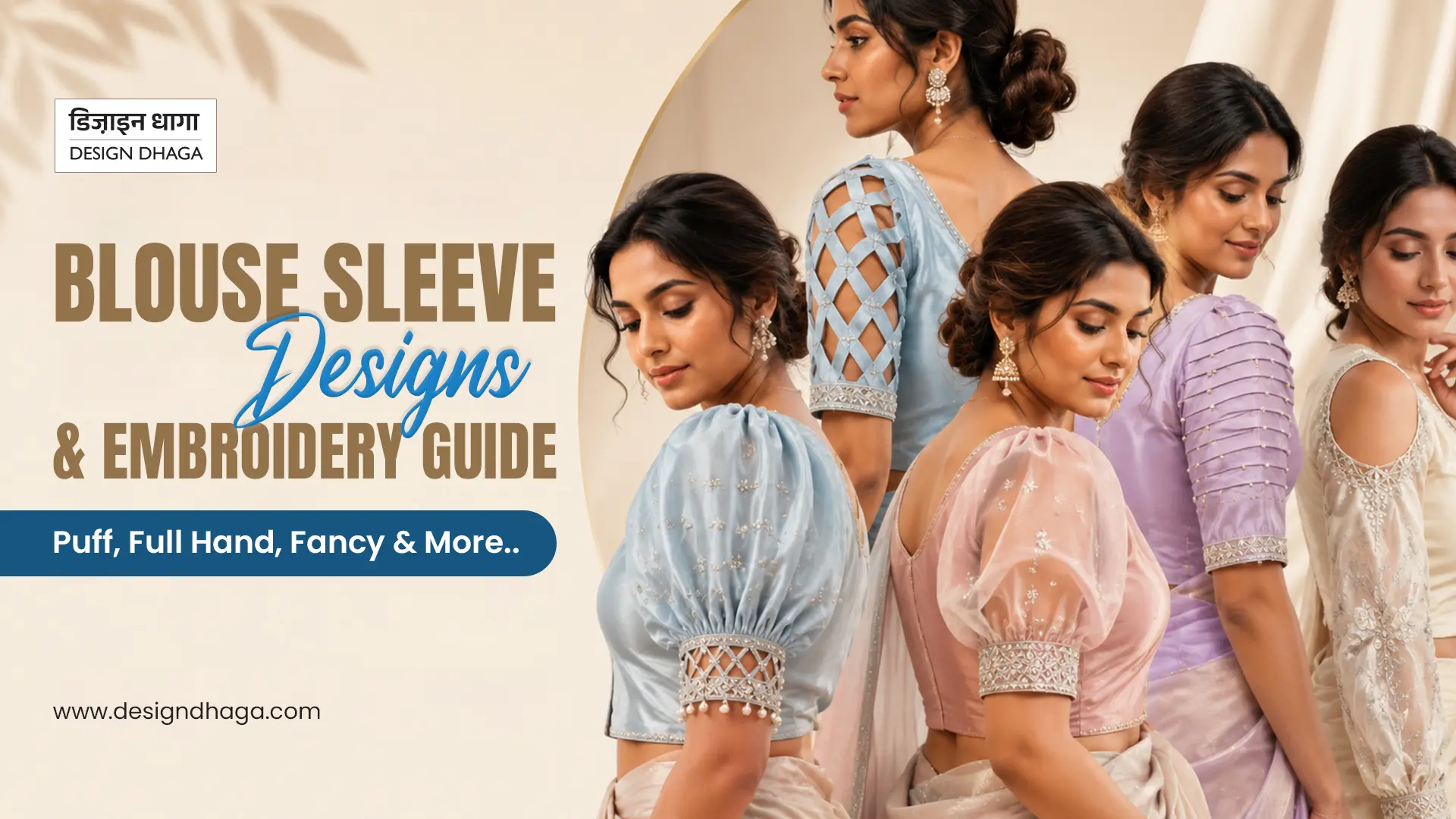
After the neckline and back design the sleeve is the third major design decision for a blouse and it's often where the most visible, most photographed detail lives. The right sleeve design can transform a plain saree into a statement look and the wrong one can make even a richly embellished saree look incomplete. This guide covers every major sleeve style, the embroidery and surface treatments that work best on each and how to choose based on occasion, fabric and the saree or lehenga being paired.
Why Sleeve Design Matters More Than Most Women Realise
In most saree and lehenga silhouettes the blouse sleeve is one of the few parts of the outfit that's clearly visible, unobstructed by the drape. The pallu covers part of the front the saree skirt covers the body but the arms and therefore the sleeves remain visible throughout. This makes sleeve design one of the highest-impact blouse decisions particularly for occasions that involve movement, dancing or extended photography.
Part 1: Sleeve Length Options

Full Hand Blouse Designs
Full-length sleeves extending to the wrist remain one of the most requested blouse styles for both traditional and contemporary occasions. Full hand blouse designs offer maximum coverage which makes them practical for formal religious ceremonies, older family members who prefer traditional styling and winter weddings where shorter sleeves would be uncomfortable.
Modern full hand designs have moved well beyond the plain straight sleeve into significantly more detailed territory:
- Full hand blouse designs with embroidery: Zari or thread embroidery running the length of the sleeve often matching the saree's border motif.
- Full sleeve with net panels: The upper sleeve in solid fabric transitioning to sheer net below the elbow, adds elegance and lightness to what can otherwise be a heavy, covered look.
- Full hand blouse designs with contrast cuff: A contrast-colour band at the wrist in matching embroidery or fabric, echoing the saree's border detail.
Three-Quarter Sleeve Blouse Designs
Three-quarter sleeves ending mid-forearm are one of the most practical choices for active occasions, long enough for coverage and elegance, short enough for comfort and movement. They work particularly well for sangeet and mehendi functions where you want a traditional look without the restriction of a full sleeve through hours of dancing.
Elbow-Length Sleeves
Ending at or just below the elbow this sleeve length is a middle ground between three-quarter and short comfortable, traditional-looking and practical for most festive occasions regardless of season.
Short Sleeves (Cap and Standard)
Short sleeves remain appropriate for casual festive wear and everyday ethnic outfits. Girlish blouse designs frequently use cap sleeves with decorative trim for a lighter, more youthful silhouette.
Sleeveless Blouse
Sleeveless blouses with a clean-cut armhole are used for contemporary, often fusion-style ethnic looks and for occasions where maximum comfort is a priority (summer weddings, beach events, destination functions). A sleeveless blouse paired with a heavily embellished saree creates a deliberate contrast: the elaborate saree against the clean, minimal blouse.
Part 2: Sleeve Shape and Structure

Puff Sleeve Blouse Designs
Puff sleeve blouse designs have transitioned from a brief trend into a lasting fixture of ethnic blouse design in 2026. The gathered rounded volume at the shoulder creates a structured, slightly vintage silhouette that adds personality to an otherwise plain kurta or saree blouse.
Puff sleeve variations:
- Small puff at shoulder only: Subtle, wearable for both office and festive settings.
- Full bishop sleeve: Puffed from shoulder to wrist with a fitted cuff more dramatic, better suited to reception or evening wear.
- Puff with net overlay: A puffed shape in sheer net over a fitted inner sleeve adds volume and lightness simultaneously.
What pairs best with puff sleeves: Plain or lightly embellished sarees and lehengas the puff sleeve is already a statement, so the outfit underneath should let it stand out rather than competing with it. A plain silk or cotton saree with a puff-sleeve blouse is one of the strongest contemporary ethnic looks available.
Fancy Blouse Sleeves Design
Fancy blouse sleeves design covers a range of statement sleeve styles beyond puff:
- Cold-shoulder sleeves: Fabric cut away at the shoulder point, leaving the shoulder exposed contemporary, works well with georgette or chiffon sarees.
- Bell sleeves: Fitted at the top, dramatically flared from the elbow, a festive choice that adds movement and drama.
- Ruffle sleeves: Layers of fabric ruffles along the sleeve length, works best in lightweight fabrics like georgette or chiffon where the ruffles can fall naturally rather than stiffly.
- Layered or tiered sleeves: Multiple short layers stacked along the sleeve creates a decorative, textured effect.
Latest Blouse Sleeve Design and New Blouse Sleeves Design (2026 Trends)

The most current sleeve directions as of 2026:
- Asymmetric sleeves: One sleeve full-length, one sleeveless an unexpected contrast that reads very contemporary.
- Sheer full sleeve with embroidered cuff: Maximum coverage, minimal weight, the sheer fabric shows the arm through the sleeve the embroidered cuff provides decoration at the most visible point.
- Structured balloon sleeve: Different from a standard puff in that the structure comes from internal boning or a stiffer fabric rather than gathering holds its shape through an entire event without collapsing.
Unique Blouse Sleeves Design
Beyond trends unique sleeve designs are increasingly custom-ordered specific cuts, unusual sleeve shapes or personally significant embroidery motifs stitched into the sleeve. For brides especially having a unique sleeve design that echoes a specific motif (a family heirloom pattern, a regional embroidery tradition or a personalized design) has become one of the most meaningful ways to add individuality to a bridal blouse.
Part 3: Embroidery and Surface Treatment
Blouse Design Embroidery

Embroidery is the most common surface treatment for blouse sleeves and fronts and understanding the types helps you match the embroidery style to the occasion and the saree being paired:
- Zari embroidery: Gold or silver metallic thread work, the most traditional, appropriate for formal and bridal occasions.
- Thread embroidery (multicolour): Colourful thread patterns works for festive and casual occasions, less formal than zari.
- Resham (silk thread) embroidery: Softer finish than zari, slightly less formal but equally detailed works well for daytime functions.
- Aari work: Fine chain-stitch embroidery using a hooked needle delicate, intricate, popular for bridal blouses and high-detail pieces.
- Chikankari: White thread embroidery on white or pastel fabric the most subtle, elegant embroidery option works for both formal and casual festive settings.
Blouse Designs Patch Work
Blouse designs patch work uses fabric patches often in contrasting colours or patterns applied to the blouse surface to create geometric or abstract designs. Patchwork blouses work particularly well with plain cotton or linen sarees where the patchwork itself becomes the visual centerpiece rather than a complement to existing embellishment.
Blouse Cut Work Design
Blouse cut work design involves carefully cutting sections of the fabric to create a delicate, almost lace-like pattern. Cutwork is typically done on cotton or silk and creates a distinctive texture that photographs well while remaining lightweight. Cutwork designs work well for daytime functions and moderate festive occasions they're more detailed than a plain blouse but less formal than heavy embroidery.
Blouse With Net Design
Blouse with net design incorporates sheer net panels into the blouse structure typically at the sleeves the back or as a yoke at the front. Net panels add visual interest, show skin elegantly without being overtly open and reduce the weight of what would otherwise be a fully covered blouse. This is one of the most requested contemporary blouse treatments for both saree and lehenga blouses.
Silk Saree Blouse Sleeves Design
Silk saree blouse sleeves design has specific requirements that differ from cotton or georgette blouse sleeves:
- Silk fabric needs precise stitching at the sleeve attachment the weight of silk means even small imprecisions in the armhole construction pull and distort the sleeve.
- Embroidery on silk saree blouses works best in matching silk thread or zari rather than heavier materials that can distort the drape.
- For heavily embellished Banarasi or Kanjivaram silk sarees a blouse sleeve in contrast fabric (plain silk in a complementary colour) often works better than trying to match the saree's zari work on the sleeve.
Part 4: Plain and Simple Blouse Styles

Blouse Designs Simple and Simple Blouse Styles
Not every occasion calls for elaborate sleeves or heavy embroidery and understanding when to choose a simple blouse is as important as knowing which elaborate options exist.
When to choose a simple blouse:
- When the saree itself is heavily embellished. (Banarasi, Kanjivaram, heavily embroidered)
- For everyday office ethnic wear where elaborate sleeves would look overdressed.
- For religious ceremonies where simplicity is appropriate.
- When the back design is already the statement piece.
Blouse designs for plain blouse and blouse plain design: Plain blouses unembellished, in a solid colour work best when they're chosen in a high quality fabric (pure silk, raw silk, or cotton) and tailored precisely. A well-fitted plain blouse in quality fabric reads more sophisticated than a poorly fitted embellished one.
Blouse designs simple with one accent: The modern update on the plain blouse is a single accent detail a contrast piping at the neckline edge, a single row of pearl buttons at the back or a small cutwork panel at the sleeve hem rather than leaving the blouse completely unadorned.
Part 5: Half Saree Blouse Designs
Half saree blouse designs have their own specific considerations since the half saree is worn primarily by young girls and young women for coming-of-age ceremonies, festivals and cultural functions predominantly in South India.
The blouse for a half saree is typically:
- Short-sleeved or three-quarter sleeved. (in keeping with the traditional half saree silhouette)
- Fitted, to anchor the skirt and dupatta of the half saree.
- Often embellished to match the half saree's border, particularly for ceremonies.
Contemporary half saree blouse designs have updated the traditional cut with modern necklines (boat neck, sweetheart) and back designs (V-back, dori closure) while keeping the overall length and fit consistent with the traditional form.
Fancy Saree Blouse Designs
Fancy saree blouse designs combine elaborate sleeve styles, statement necklines and surface treatments into a single blouse typically reserved for receptions, sangeet functions and high-formal occasions where the blouse is as much a focal piece as the saree itself. The key to making a fancy blouse work is ensuring that at least one element (sleeve, neckline, or back) is restrained trying to maximise all three simultaneously usually results in a blouse that looks busy rather than elegant.
Choosing a Sleeve Design by Occasion
|
Occasion |
Best sleeve choice |
|
Wedding ceremony |
Full hand with embroidery or net panel |
|
Reception |
Puff sleeve or fancy/bell sleeve |
|
Sangeet/Mehendi |
Three-quarter with ruffle or tiered sleeve |
|
Office/formal |
Simple short or three-quarter, minimal detail |
|
Everyday festive |
Cap sleeve, elbow length, or simple short sleeve |
|
Religious ceremony |
Full hand, plain or simple embroidery |
|
Evening/party |
Cold shoulder or asymmetric sleeve |
Getting Sleeve Construction Right
The most common sleeve-related tailoring problem is a pulling or bunching at the armhole caused by imprecise armhole curve construction or mismatched sleeve cap height, before finalizing any blouse:
- Raise both arms above your head fully - no pulling at the armhole
- Bring arms forward fully - no restriction at the back
- If the sleeve is puffed or structured, check that the volume sits at the shoulder point and not sliding forward or backward
For embroidered and net-panel sleeves specifically: ask the tailor to use French seams or bound seam allowances at the sleeve attachment, since raw edges can fray and shift under the embroidery over time.
Common Mistakes to Avoid
- Choosing a dramatic sleeve for a heavily embellished saree : a puff sleeve or bell sleeve competes with a busy saree border rather than complementing it.
- Ignoring sleeve length relative to arm length : standard blouse sleeve lengths are sized for average arm lengths; if your arms are longer or shorter, always adjust the sleeve length at fitting.
- Choosing net panels without a lining underneath : unlined net panels cling and shift in ways lined ones don't always confirm whether net sections are lined before finalizing.
- Adding embroidery to a plain silk saree blouse without testing on a fabric scrap first : embroidery needles can leave visible holes in silk if the wrong needle gauge is used.
Final Thoughts
Sleeve design is where you have the most creative freedom in a blouse, it's not constrained by draping logic the way neckline and back design are, and the range from plain cap sleeve to full bishop sleeve with embroidery is enormous. Choose with the occasion and the saree's own detail level in mind: let the sleeve be the statement when everything else is simple and let the sleeve step back when the saree, back design or neckline is already doing the visual work.
Explore our full blouse collection : including embroidered, patchwork, and contemporary sleeve styles at the Design Dhaga Blouse Collection.
“Frequently Asked Questions”
Q: What sleeve design is currently most popular for saree blouses in 2026? Puff sleeves and sheer net full-length sleeves are the two most requested styles in 2026, puff sleeves for their structured, contemporary silhouette and net full sleeves for combining coverage with lightness.
Q: Can I add embroidery to a plain silk saree blouse? Yes, but use the correct needle gauge for silk (a fine sharp needle, not a standard embroidery needle) and test on a fabric scrap first, since silk is more vulnerable to needle-hole distortion than cotton or georgette.
Q: What is the difference between patchwork and cutwork blouse designs? Patchwork uses applied fabric pieces in contrasting colours or patterns stitched onto the blouse surface. Cutwork removes sections of the existing fabric to create a lace-like pattern the opposite technique, creating openings rather than additions.
Q: Should the sleeve embroidery match the saree's border exactly? Not necessarily matching the motif family (floral, geometric, paisley) is usually more effective than trying to exactly replicate the saree's border embroidery on the sleeve since exact replication can look forced. A complementary, coordinating motif in the same colour palette tends to look more natural and intentional.
.webp)

.webp)

.webp)
.webp)

.webp)


 Continue with Google